

CBD Research & Evidence Hub
What Does the Science Actually Say About CBD?
CBD has become the subject of a growing amount of scientific research, media coverage and online discussion. Search for CBD alongside almost any health-related topic and you are likely to find studies, personal experiences and product claims — often reaching very different conclusions.
But research into CBD is not the same as proof that a consumer CBD product can treat a medical condition.
The Incr-edibles CBD Research & Evidence Hub, part of CBD 4 Me, has been created to examine the evidence behind some of the most commonly searched questions about CBD.
Rather than simply repeating claims found online, we look at what has actually been studied, the quality and limitations of the evidence, what substance researchers investigated and whether the findings can reasonably be applied to consumer CBD products.
Our aim is simple:
To help consumers understand the difference between CBD research, emerging evidence and established fact.
How We Review CBD Evidence
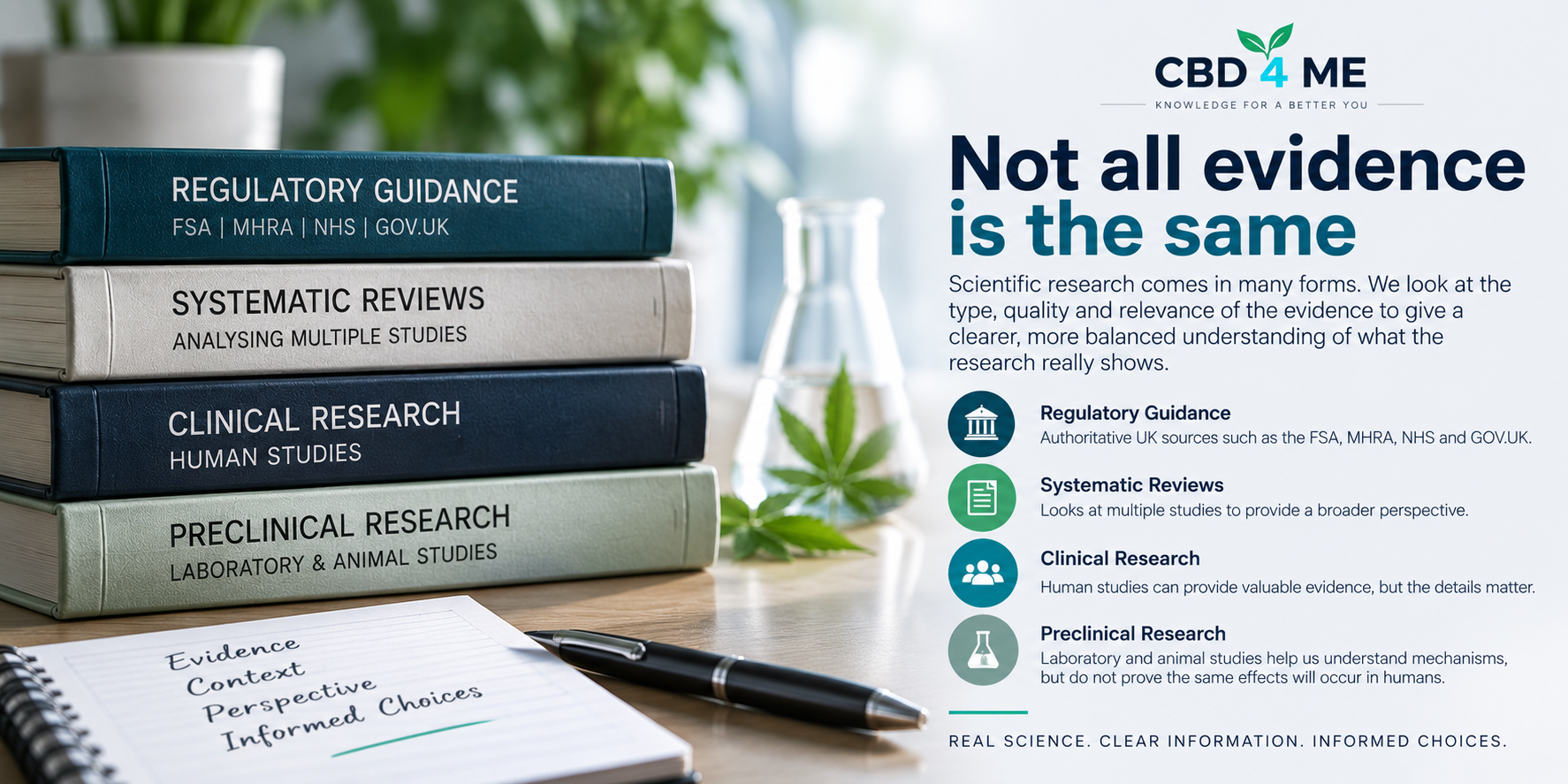
Not All Scientific Evidence Is Equal
The word “study” can describe many very different types of research.
A laboratory experiment involving cells, an animal study, an observational study and a controlled human clinical trial can all legitimately be described as scientific research.
But they do not provide the same level of evidence.
When reviewing CBD research, we therefore consider the type, quality and relevance of the evidence, rather than simply whether a study exists.
1. Official UK Health & Regulatory Guidance
Where relevant, we start with authoritative UK sources such as the:
Food Standards Agency (FSA)
Medicines and Healthcare products Regulatory Agency (MHRA)
NHS
GOV.UK
These sources are particularly important when considering CBD safety, medicines, food regulation, Novel Foods and current UK consumer guidance.
2. Systematic Reviews & Evidence Reviews
Rather than considering only one individual study, systematic reviews examine evidence from multiple studies using a defined methodology.
Where high-quality reviews are available, they can help provide a broader picture of the available evidence.
However, a review is still influenced by the quality, size and relevance of the studies included within it.
3. Human Clinical Research
Research conducted in humans can provide valuable evidence, but the details matter.
When examining a clinical study, we consider questions such as:
- How many people participated?
- Was there an appropriate control or placebo group?
- What substance or formulation was actually tested?
- Was CBD studied alone or alongside other cannabinoids?
- How much was administered?
- How long did the study last?
- What outcomes were measured?
- Were the findings statistically and clinically meaningful?
- Have the findings been replicated?
We also consider whether the product being investigated resembles the type of consumer CBD product available in the UK.
This is important because findings involving one cannabinoid formulation cannot automatically be applied to another.
4. Laboratory & Preclinical Research
Laboratory and animal studies are an important part of scientific research.
They can help researchers investigate biological mechanisms, understand how substances interact with biological systems and identify areas worthy of further study.
However, an effect observed in cells or animals does not establish that the same effect will occur in people consuming a CBD food product.
Where research is preliminary or preclinical, our Evidence Guides aim to make that clear.
Research Does Not Automatically Mean a Health Benefit Has Been Proven
This is one of the most important principles behind the Incr-edibles Research & Evidence Hub.
Scientific researchers can investigate CBD in relation to a health condition without demonstrating that CBD is an effective treatment for that condition.
Research might identify a possible biological mechanism.
A small study might produce an interesting result.
An observational study might identify an association.
These findings can help researchers decide what should be investigated next.
But:
Research does not automatically equal proof.
And:
Research involving CBD does not automatically establish that a consumer CBD product provides a particular health benefit.
Our Evidence Guides therefore look at the strength and relevance of the evidence, rather than simply collecting studies that appear to support a particular conclusion.
Why CBD Research Headlines Can Be Misleading
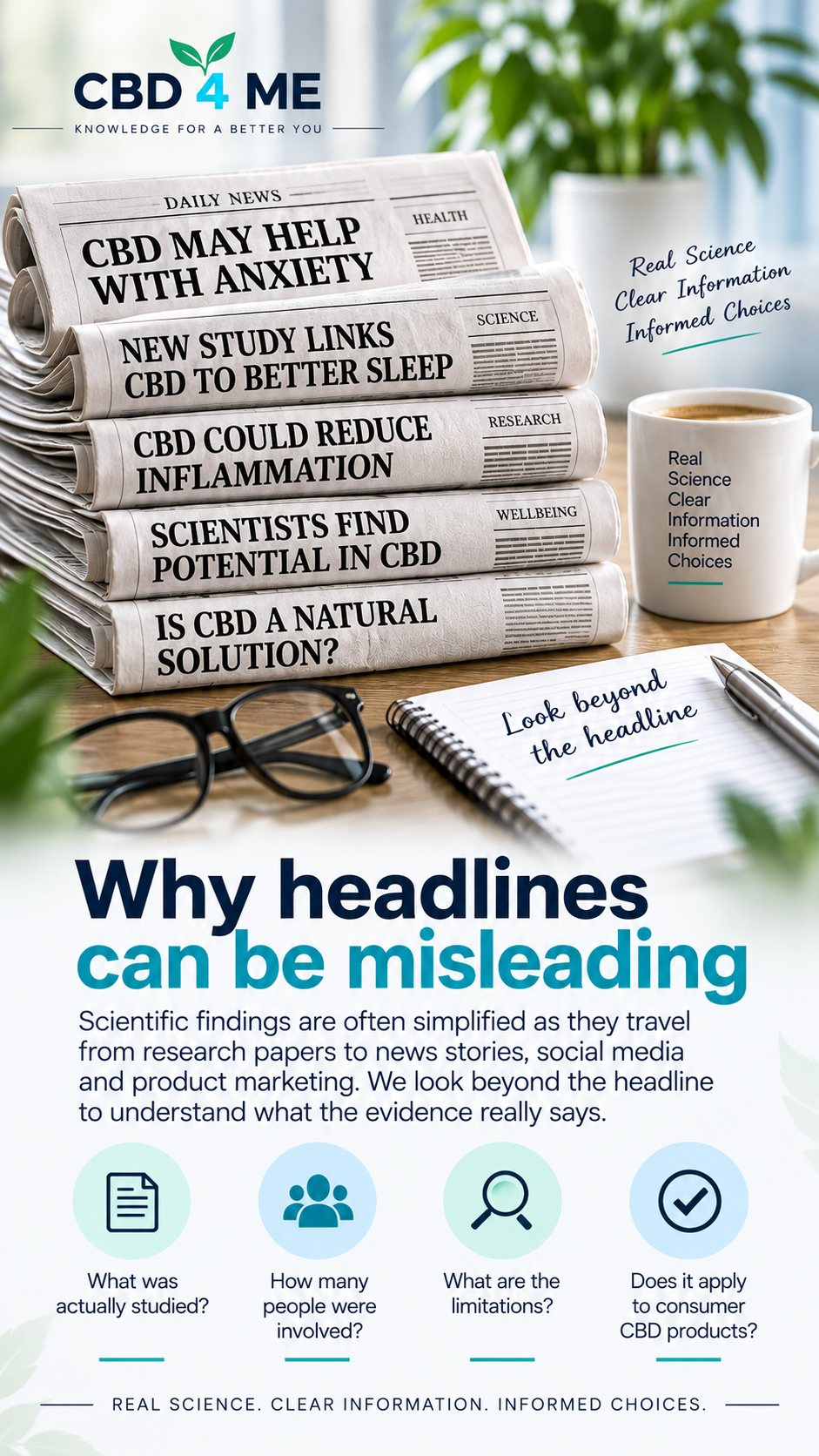
Scientific research is complex. Headlines generally aren’t.
As research moves from scientific papers into news stories, websites and social media, important qualifications can disappear.
For example, a scientific paper might conclude that:
“Further research is warranted.”
That can be reported as:
“CBD may help…”
which can eventually become:
“CBD helps…”
or even:
“CBD treats…”
Those statements do not mean the same thing.
That’s why we look beyond the headline and ask:
What was actually studied?
Was the research conducted in humans?
Was CBD studied independently?
What formulation was used?
How large was the study?
Was there a control group?
Have the findings been replicated?
What limitations did the researchers identify?
And importantly:
Does the research actually relate to the type of consumer CBD product being discussed?
These questions can substantially change how research findings should be interpreted.
Consumer CBD and Cannabis-Based Medicines Are Not the Same
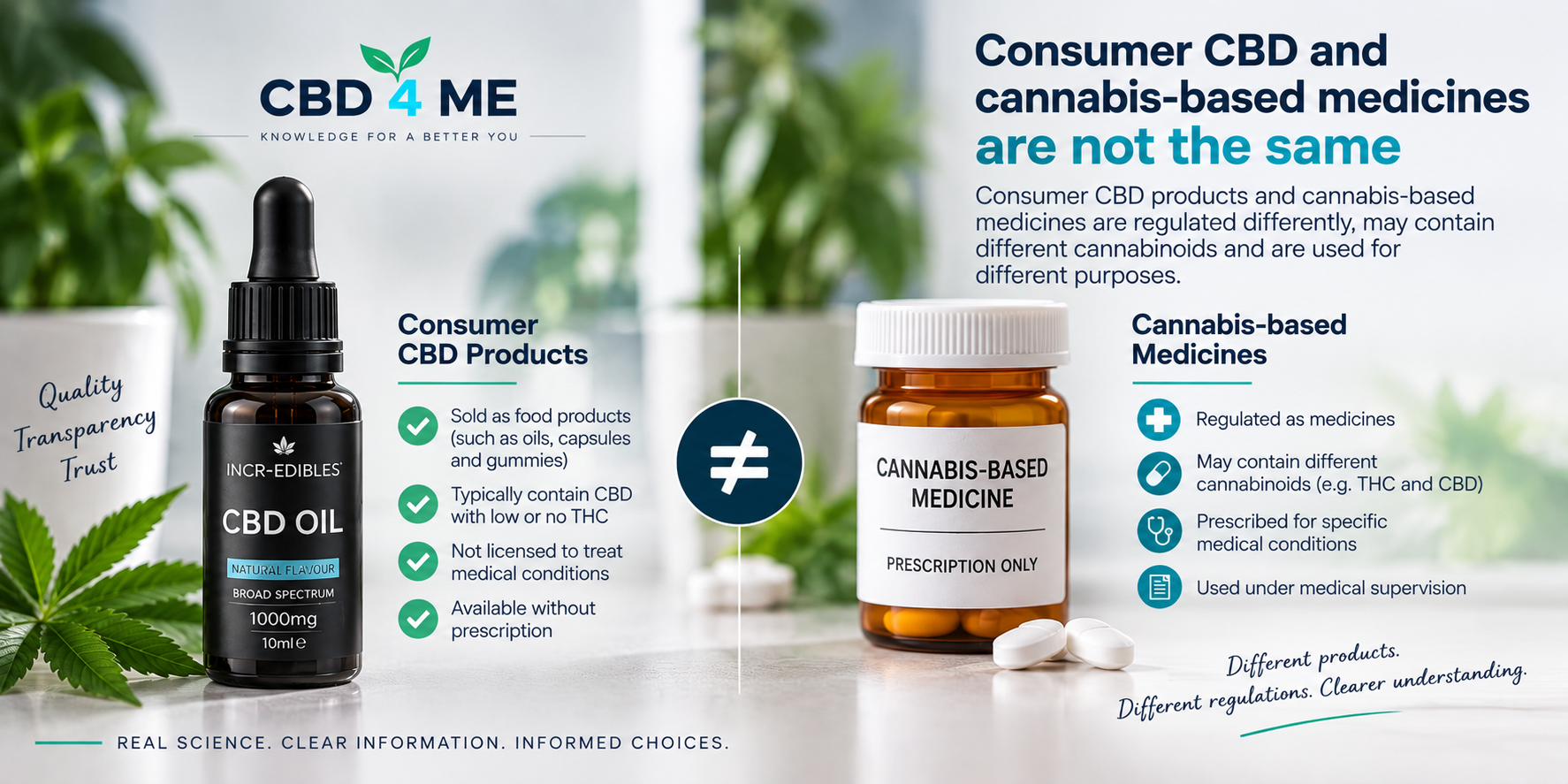
Another important source of confusion is the relationship between consumer CBD products and cannabis-based medicines.
They are not interchangeable.
CBD oils, gummies, capsules and other ingestible CBD products sold to consumers in the UK are generally supplied as foods rather than medicines.
Cannabis-based medicinal products operate within a different regulatory framework and may use different cannabinoids, formulations, concentrations and methods of administration.
Scientific research may also involve pharmaceutical preparations administered under controlled conditions.
The existence of evidence relating to a medicine or pharmaceutical preparation should therefore not automatically be interpreted as evidence that an ordinary consumer CBD product will produce the same outcome.
Throughout our Evidence Hub, we aim to identify what researchers actually studied wherever this distinction is relevant.
CBD Research and Health Claims
The existence of scientific research into CBD does not mean unrestricted health or medicinal claims can be made about CBD foods.
Consumer CBD products should not be marketed as products that diagnose, prevent, treat or cure medical conditions.
There are currently no authorised health claims for CBD foods that permit claims such as CBD relieving pain or improving sleep.
This is why our Evidence Hub distinguishes carefully between:
scientific investigation
preliminary findings
clinical evidence
consumer CBD products
and
medicines.
An interesting research finding can be worth discussing without turning it into a product claim.
CBD Safety & Current UK Guidance
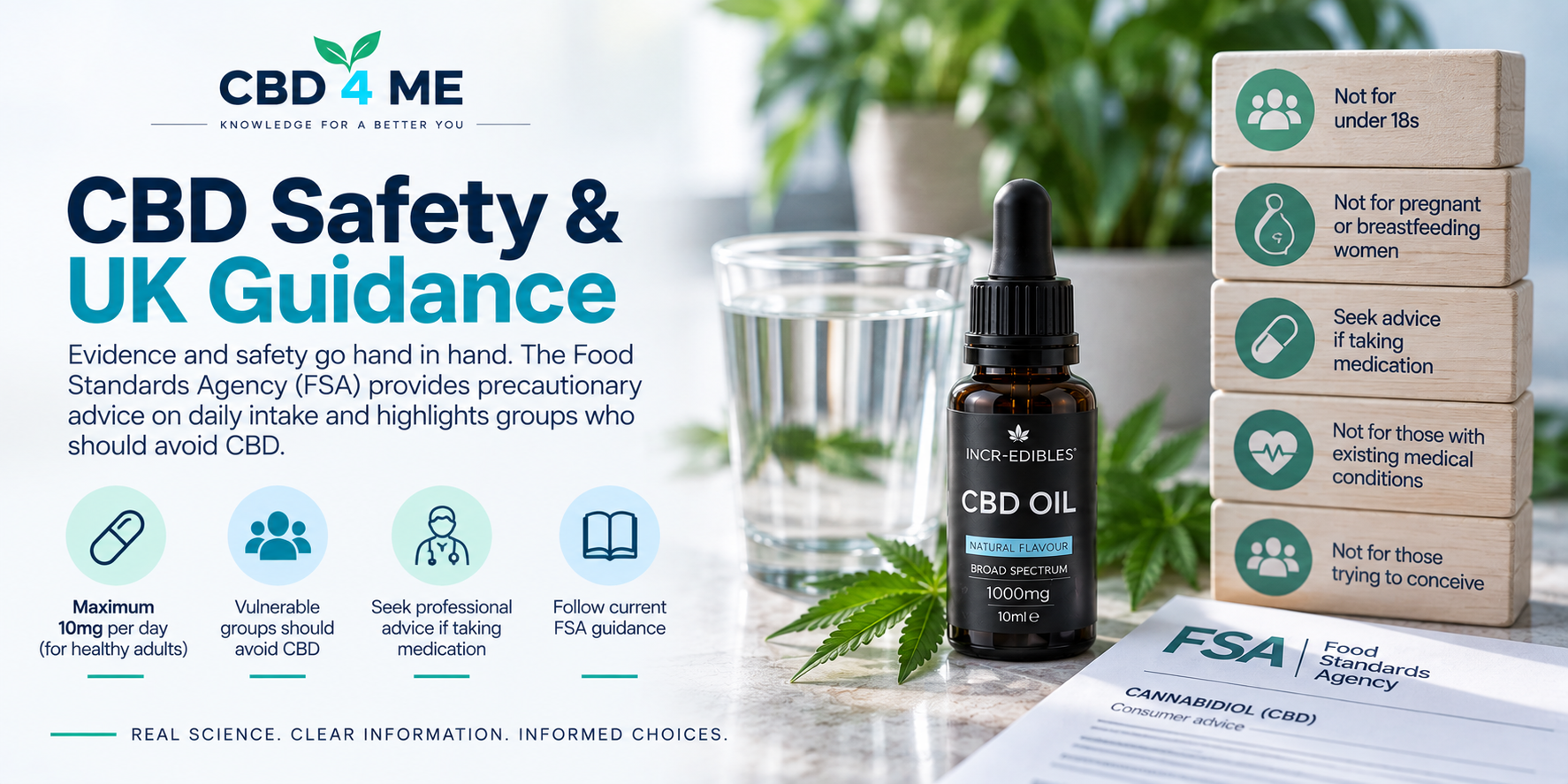
Evidence and safety should be considered together.
Current Food Standards Agency precautionary advice recommends that healthy adults consume no more than 10mg of CBD per day from CBD food products.
The FSA also advises that people in vulnerable groups should avoid CBD unless under medical direction.
This includes people who are:
- taking medication;
- pregnant or breastfeeding;
- trying to conceive; or
- under 18.
Anyone with an existing medical condition or who takes medication should seek appropriate professional advice before using CBD.
UK guidance reviewed: September 2026
Understanding CBD and the UK Novel Food Process
CBD extracts used in foods are subject to the UK’s Novel Food requirements.
The Food Standards Agency maintains a public list of CBD products linked to Novel Food applications.
Where an application has been validated, this means that the application contained the information required to progress through the Novel Food assessment process.
There is an important distinction for consumers to understand:
Appearance on the FSA public list does not mean that the Food Standards Agency endorses a CBD product or that final Novel Food authorisation has been granted.
At Incr-edibles, we believe this information should be explained clearly rather than using regulatory terminology without context.
View our FSA validated CBD products and their individual FSA listings →
Evidence Isn’t Just About Research — Product Transparency Matters Too
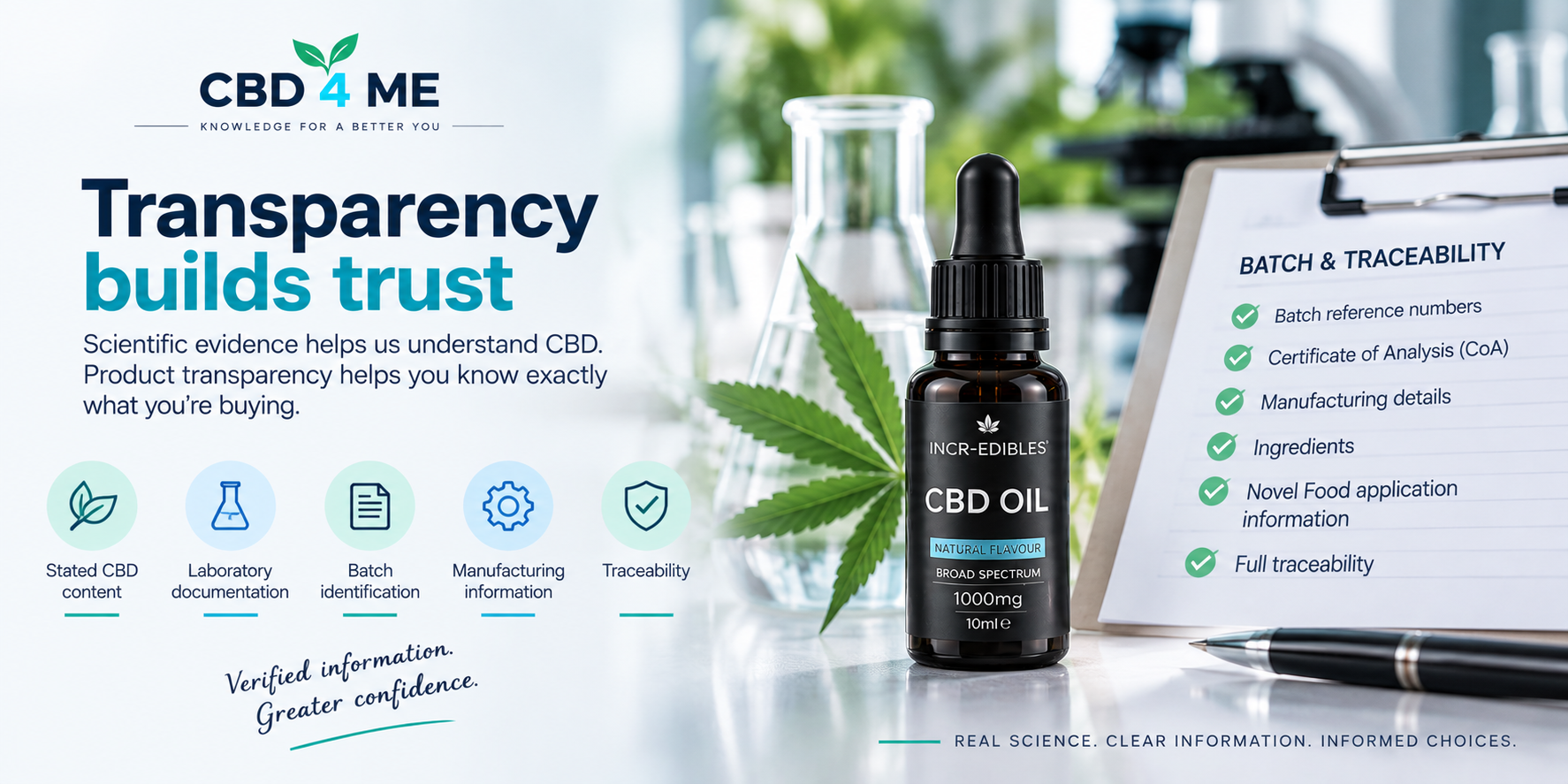
Scientific evidence can help us understand what researchers know about CBD.
But when choosing a consumer CBD product, there is another kind of evidence that matters:
evidence of what is actually inside the product.
Useful information can include:
- stated CBD content;
- bottle size and concentration;
- cannabinoid composition;
- complete ingredients;
- batch identification;
- laboratory documentation;
- manufacturing information;
- traceability; and
- relevant Novel Food application information.
These are measurable pieces of information that consumers can use when comparing products.
At Incr-edibles, we’ve invested heavily in making product and manufacturing information accessible because we believe CBD should be evaluated using transparent, verifiable information rather than exaggerated promises.
Explore our product batch & traceability information →
scientific evidence tells the customer what is known about CBD; product evidence tells them what is known about the CBD they’re buying.
Our Approach to CBD Evidence
We don’t believe responsible CBD education means arguing that CBD is either a miracle product or that research into it has no value.
The evidence is more nuanced than either position.
CBD and other cannabinoids continue to be investigated across many areas of science.
Some areas have considerably more evidence than others.
Some findings are preliminary.
Some research involves animals or laboratory models.
Some involves humans.
Some research involves CBD.
Other studies investigate combinations of cannabinoids or cannabis-based medicines.
Those distinctions matter.
Our approach across CBD 4 Me Research & Evidence is therefore:
If the evidence is strong, we’ll explain why.
If the evidence is limited, we’ll say it’s limited.
If studies disagree, we’ll explain the uncertainty.
If research involves a medicine rather than a consumer CBD product, we’ll make that distinction clear.
If evidence does not establish that CBD provides a particular health benefit, we won’t present it as though it does.
Research Changes — So Our Evidence Hub Will Too
Scientific understanding develops over time.
New studies are published, evidence reviews are updated and regulatory guidance can change.
Sometimes new research strengthens an existing hypothesis.
Sometimes it challenges earlier conclusions.
The Incr-edibles CBD Research & Evidence Hub is therefore intended to be a living resource.
Our Evidence Guides will be reviewed as relevant evidence and UK guidance develops, with review dates provided where appropriate.
This allows readers to see not only what the evidence says, but also when our interpretation was last reviewed.
CBD 4 Me: Helping You Understand CBD
The Research & Evidence Hub forms part of our wider CBD 4 Me consumer education resource.
Research is only one part of understanding CBD.
Across CBD 4 Me we also explore subjects including CBD oil, product strength and concentration, ingredients, manufacturing, safety, drug testing, product formats, laboratory documentation and traceability.
The objective throughout is the same:
Clear information. Transparent evidence. Informed choices.
Explore CBD 4 Me

Sources & Further Reading
For readers who want to explore the underlying UK guidance further, we recommend starting with authoritative sources including:
Food Standards Agency (FSA) — Consumer guidance on cannabidiol (CBD), CBD food products and current precautionary intake advice.
Food Standards Agency (FSA) — Information about CBD Novel Food applications and the public CBD products list.
Medicines and Healthcare products Regulatory Agency (MHRA) — Guidance concerning products containing cannabidiol and medicines regulation.
NHS — Information concerning medical cannabis and cannabis-based medicines.
GOV.UK — UK government guidance and regulatory information concerning cannabidiol.
Last reviewed: September 2026
The Incr-edibles CBD Research & Evidence Hub provides general consumer information about CBD and scientific research. It does not provide medical advice and should not be used to diagnose, prevent or treat a medical condition.